Korean history in steps
Step 1 of 11

Gojoseon and early Korea

to 108 BCE
Gojoseon means “Old Joseon”

People have lived on the Korean peninsula for many thousands of years. The first Korean state named in historical records, Gojoseon, grew up in the north and in what is now north-east China, until China’s Han dynasty conquered it in 108 BCE. Its founding legend, the story of Dangun (legendary founder of Gojoseon), is still told today.

About 6 minutes

Who you’ll meet

One key name in this era. Everyone else plays a smaller part: tap their name in the text whenever you need a reminder.

Also appearing (4)
Practise this era’s names

Where it happened

Tap a marker, a shaded region or a name below the map to see what happened there. Places in the text with a red pin open their own map card.

Region

Liaoning

Gojoseon may have been centred here before it moved to the peninsula. Historians still debate where its heartland lay.

Coastlines from Natural Earth. Kingdoms and regions are shown by name only, without borders.

Open the atlas to compare this map with other eras, or browse all places.

What happened

Hunter-gatherers lived on the peninsula in the Old Stone Age. From around 8000 BCE, people of the Neolithic Jeulmun culture made pottery decorated with comb-like patterns, fished and gathered shellfish along the coasts and rivers, and in time began to grow millet.

Around 1500 BCE the Mumun, or “plain pottery”, period began, with rice farming, larger villages and bronze. Leaders of this age were buried beneath dolmens, great stone tables. Korea has tens of thousands of them, and the dolmen sites of Gochang, Hwasun and Ganghwa became a UNESCO World Heritage Site in 2000.

Gojoseon is the first Korean state named in historical records. Chinese texts mention it from at least the 4th century BCE, when it lay in today’s Liaoning region or in the north-west of the peninsula; historians still debate where its centre was and when it moved. Its bronze culture is known for distinctive lute-shaped daggers.
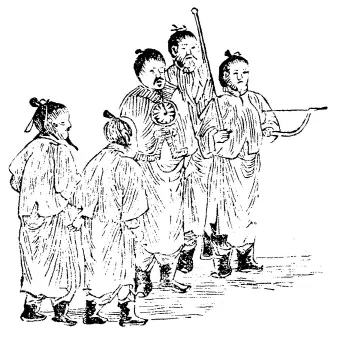
Wiman
Wiman Public domain, Wikimedia Commons

Around 194 BCE a man named Wiman (king who seized Gojoseon), who had fled the Chinese state of Yan, seized Gojoseon’s throne. His grandson, King Ugeo (last king of Gojoseon), was ruling when Emperor Wu of Han (Chinese emperor who conquered Gojoseon) sent armies against it, and in 108 BCE the capital, Wanggeom-seong, probably near today’s Pyongyang, fell. Han set up commanderies in the north; the best known, Lelang, lasted until 313 CE. Meanwhile new peoples and states were forming: Buyeo in the north, and three confederations in the south, Mahan, Jinhan and Byeonhan.

Words worth knowing

Gojoseon

“Old Joseon”, the name historians use to tell the first state apart from the Joseon dynasty of 1392–1897.

Dolmen

A Bronze Age tomb marker made of a large flat capstone resting on upright stones or boulders. In Korean, goindol.

Mumun

“Without pattern”: the plain pottery of the Bronze Age farmers, which gives the period its name.

Samhan

The three Han confederations of the south: Mahan, Jinhan and Byeonhan. This Han is a Korean word, written with a different character from China’s Han dynasty.

Did you know?

What did Gojoseon’s laws say?

Chinese histories record that Gojoseon had eight laws. Three survive: a killer was put to death, a person who injured another paid in grain, and a thief became a slave of the victim’s household.

Why does the founding legend feature a bear?

In the legend, a bear and a tiger asked Hwanung (heavenly prince of the legend), son of the lord of heaven, to make them human. The bear stayed in a cave eating only mugwort and garlic, became a woman after twenty-one days and bore Dangun (legendary founder of Gojoseon). The tiger gave up.

How many dolmens does Korea have?

Tens of thousands, by most estimates a large share of all the dolmens in the world. The sites at Gochang, Hwasun and Ganghwa are a UNESCO World Heritage Site.

Myth or fact?

“Korea was founded in 2333 BCE by Dangun, grandson of the lord of heaven.”

Match the names

Tap a name, then the role that goes with it.

Check yourself

Question 1 of 3

Who is the legendary founder of Gojoseon?

Question 2 of 3

Which Chinese dynasty conquered Gojoseon in 108 BCE?

Question 3 of 3

What are the great stone tables built over Bronze Age graves called?

Collect the seal

Answer all three questions above to stamp the Gojoseon seal. 0 of 3 answered.

Back to the seal book