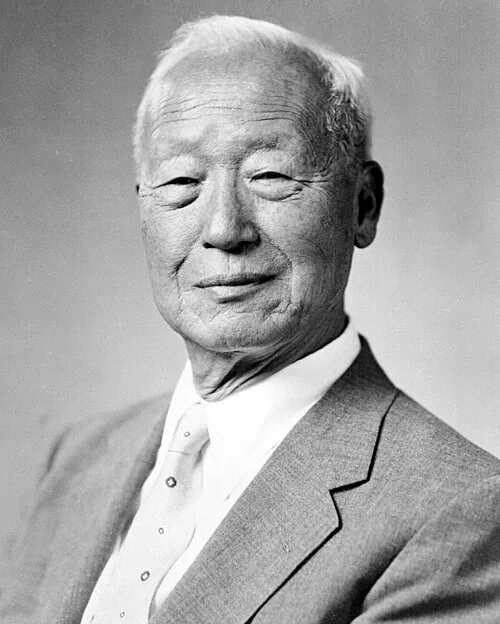

In April 1960 student-led protests against a rigged election forced Syngman Rhee (first president of South Korea) to resign, and he went into exile in Hawaii. A year later, in May 1961, General Park Chung-hee (general who ruled South Korea 1961–79) seized power in a military coup. He ruled South Korea until 1979, winning elections in the 1960s and then ruling under an authoritarian constitution.
Park made economic growth the nation’s goal. Under five-year plans, the state steered cheap loans to big family-run business groups, the chaebol, such as Samsung and Hyundai, and pushed exports, steel, shipbuilding and electronics. In 1970 the Gyeongbu Expressway linked Seoul and Busan, and in 1965 South Korea restored relations with Japan. Within a generation one of the world’s poorer countries became an industrial power.
Park also ruled harshly. In 1972 his Yusin constitution let him rule without limit, critics were jailed and workers who organised were suppressed; in 1970 the garment worker Jeon Tae-il (garment worker and activist) set himself on fire in protest at sweatshop conditions. In October 1979 Park was shot dead by his own intelligence chief. General Chun Doo-hwan (general who crushed Gwangju) then took power, and in May 1980 troops crushed a democracy uprising in Gwangju; official figures count about 200 dead or missing, and other estimates are considerably higher.
In the North, Kim Il-sung (founder of North Korea) removed his rivals and built a one-party state on his idea of Juche, “self-reliance”, with a cult of personality around himself and later his son, Kim Jong-il (second ruler of North Korea). North Korea’s economy, at first the stronger of the two, fell behind the South’s from the 1970s. In June 1987 nationwide protests forced Chun’s government to accept direct presidential elections, and South Korea became a democracy.