Korean history in steps
Step 9 of 11

Liberation and the Korean War

1945 – 1953
Gwangbok, “restoration of light”: liberation

Japan’s surrender in August 1945 freed Korea, but the United States and the Soviet Union divided it at the 38th parallel. In 1948 two rival states were founded, and in June 1950 North Korea invaded the South. Three years of war, in which the United Nations and China joined, killed millions and ended in an armistice in 1953 that left Korea divided.

About 6 minutes

Who you’ll meet

2 key names in this era. Everyone else plays a smaller part: tap their name in the text whenever you need a reminder.

Also appearing (2)
Practise this era’s names

Where it happened

Tap a marker, a shaded region or a name below the map to see what happened there. Places in the text with a red pin open their own map card.

Region

38th parallel

The dividing line of 1945. The war began and ended close to it.

Coastlines from Natural Earth. Kingdoms and regions are shown by name only, without borders.

Open the atlas to compare this map with other eras, or browse all places.

What happened

On 15 August 1945 Japan surrendered, a day Koreans celebrate as Gwangbokjeol, “restoration of light”. Soviet troops had already entered the north, and the United States proposed dividing the peninsula at the 38th parallel so that each could accept the Japanese surrender in its zone; American forces landed in the south in September. The two occupations hardened into separate states.
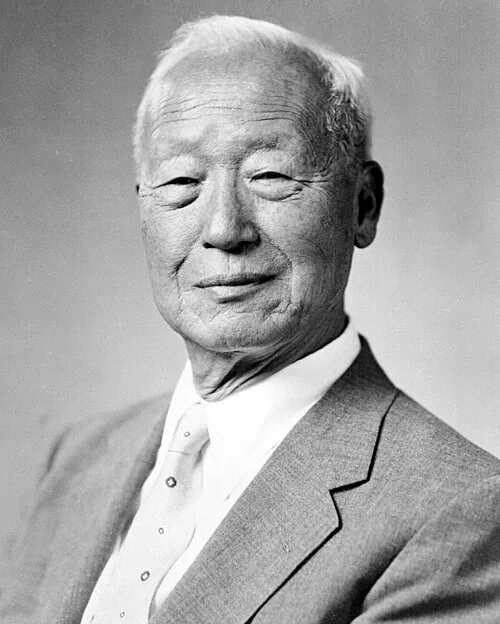
Syngman Rhee
Syngman Rhee Public domain, Wikimedia Commons

Talks on a single government failed. In 1948 elections held in the south under United Nations supervision made Syngman Rhee (first president of South Korea) president of the Republic of Korea, proclaimed on 15 August, and on 9 September the north proclaimed the Democratic People’s Republic of Korea under Kim Il-sung (founder of North Korea). In the south, an uprising on Jeju Island and its brutal suppression from 1948 killed an estimated 14,000 to 30,000 people.

On 25 June 1950 North Korean forces, with Soviet approval, invaded the South, took Seoul within days and pushed the defenders back to a small area around Busan. A United Nations force led by the United States landed at Incheon in September, retook Seoul and advanced towards the Yalu River. In October China entered the war, and its armies drove the UN forces back south.
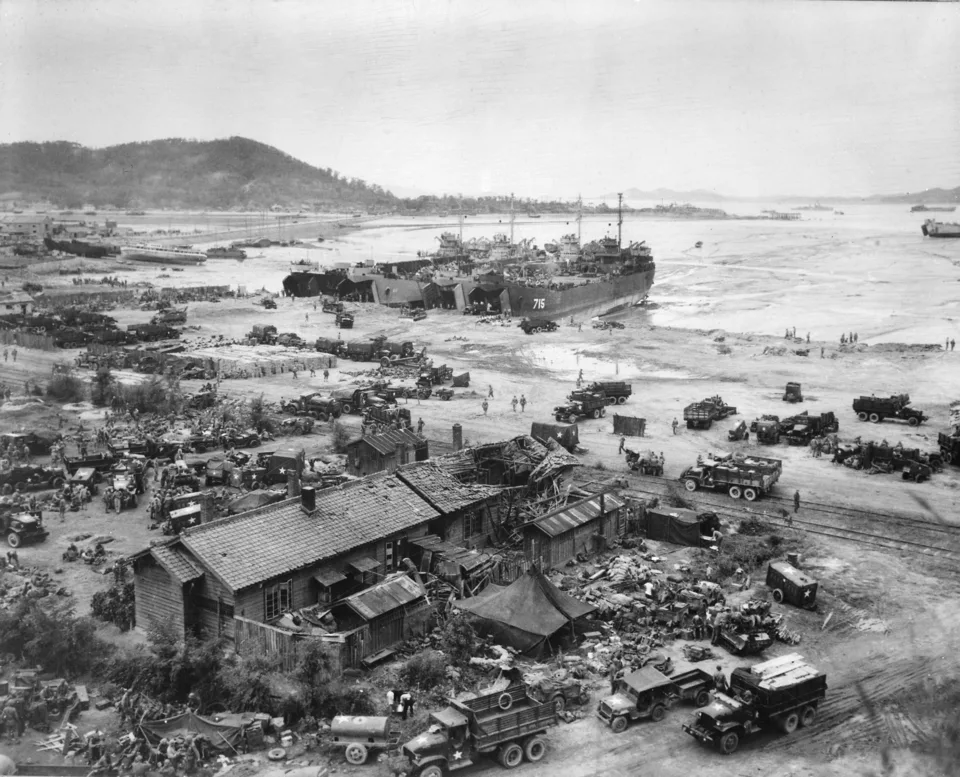
Landing ships unloading at Incheon, 15 September 1950. US Navy photograph.
Landing ships unloading at Incheon, 15 September 1950. US Navy photograph. Public domain, via Wikimedia Commons

The front then settled near the 38th parallel, and fighting went on for two more years while armistice talks dragged on. An armistice was signed at Panmunjom on 27 July 1953, but no peace treaty followed, and a demilitarised zone still divides the peninsula. Estimates of the dead, soldiers and civilians together, range from about 2.5 million to more than 3 million, and millions of families were separated.
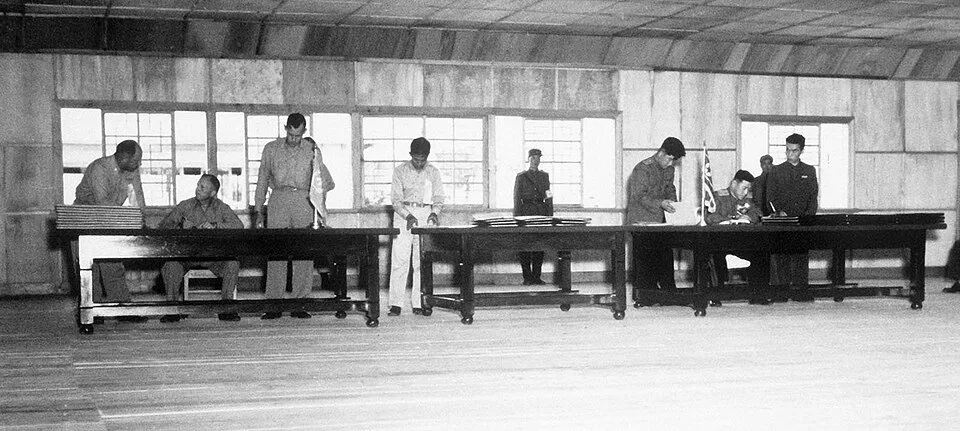
General William K. Harrison of the UN Command (left) and General Nam Il of the North Korean and Chinese side (right) signing the armistice at Panmunjom, 27 July 1953. US Department of Defense.
General William K. Harrison of the UN Command (left) and General Nam Il of the North Korean and Chinese side (right) signing the armistice at Panmunjom, 27 July 1953. US Department of Defense. Public domain, via Wikimedia Commons

Words worth knowing

Gwangbokjeol

Liberation Day, 15 August, celebrated in both Koreas as the end of Japanese rule. In the South it is also the day the republic was proclaimed in 1948.

38th parallel

The line of latitude chosen in 1945 to divide the American and Soviet zones of occupation.

DMZ

The Demilitarised Zone, a strip about four kilometres wide along the 1953 ceasefire line.

Armistice

The ceasefire agreement of 27 July 1953 that stopped the fighting. No peace treaty has followed it.

Did you know?

Has the Korean War officially ended?

No. The armistice of 1953 stopped the fighting, but no peace treaty has been signed, so the two Koreas remain technically at war.

How many countries fought under the UN flag?

Sixteen countries sent combat troops, led by the United States, and several more sent medical units.

What is Panmunjom?

The truce village on the ceasefire line where the armistice was signed in 1953. It has since hosted talks between the two Koreas, including the 2018 summit of Moon Jae-in (president of the 2018 summits) and Kim Jong-un (third ruler of North Korea).

Myth or fact?

“The Korean War has never officially ended.”

Match the names

Tap a name, then the role that goes with it.

Check yourself

Question 1 of 3

Which line divided Korea into Soviet and American zones in 1945?

Question 2 of 3

Where did UN forces land in September 1950?

Question 3 of 3

When was the armistice signed?

Collect the seal

Answer all three questions above to stamp the Korean War seal. 0 of 3 answered.

Back to the seal book