Spanish history in steps
Step 5 of 11

The Christian kingdoms and the Reconquista

1031–1479
Cid, from the Arabic sayyid, “lord”: the title of Rodrigo Díaz

As al-Andalus split into small kingdoms, the Christian kingdoms of the north pushed south: Castile took Toledo in 1085, and after the victory of Las Navas de Tolosa in 1212 Castile and Aragon conquered most of the south. By 1250 only the emirate of Granada remained. Castile, Aragon, Portugal and Navarre went their own ways until Isabella of Castile (queen of Castile) married Ferdinand of Aragon (king of Aragon).

About 6 minutes

Who you’ll meet

2 key names in this era. Everyone else plays a smaller part: tap their name in the text whenever you need a reminder.

Also appearing (5)

Families in this step: The Nasrids The house of Trastámara

Practise this era’s names

Where it happened

Tap a marker, a shaded region or a name below the map to see what happened there. Places in the text with a red pin open their own map card.

Seat of power

León

Capital of the kingdom of León.

Coastlines from Natural Earth. Kingdoms and regions are shown by name only, without borders; shaded areas follow today’s borders as a guide.

Open the atlas to compare this map with other eras, or browse all places.

What happened

The northern Christian states, Asturias and then León, Castile, Navarre, Aragon and the counties of Catalonia, grew as al-Andalus weakened. The taifa kings paid tribute to Christian rulers, and in 1085 Alfonso VI (king of León and Castile) of Castile took Toledo, the old Visigothic capital. The taifas called in the Almoravids, Berber rulers from Morocco, who defeated Alfonso VI in 1086 and took over al-Andalus.

Rodrigo Díaz de Vivar (Castilian warrior, El Cid), El Cid, fought for both Christian and Muslim rulers before taking Valencia for himself in 1094. Later the Almohads, another Berber dynasty, replaced the Almoravids. In 1212 the kings of Castile, Aragon and Navarre won a great victory over the Almohads at Las Navas de Tolosa.

Castile, united for good with León in 1230 under Ferdinand III (king who took Córdoba and Seville), took Córdoba in 1236 and Seville in 1248, while James I of Aragon (conqueror of Majorca and Valencia) conquered Majorca and Valencia. Only the emirate of Granada was left, ruled by the Nasrids, who paid tribute to Castile and built the Alhambra. In Toledo, scholars translated Arabic works, and Greek works preserved in Arabic, into Latin and Castilian.
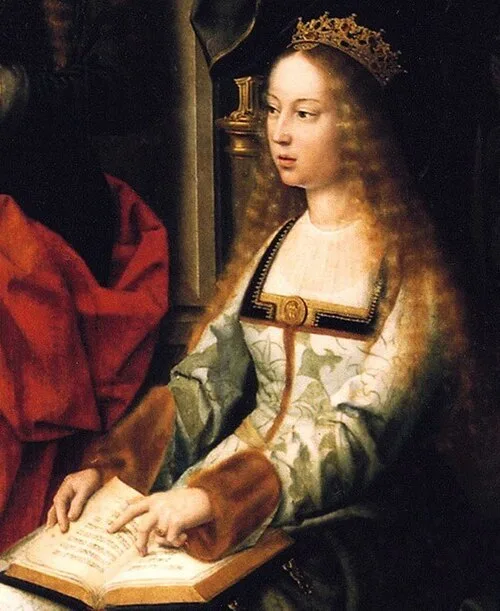
Isabella I of Castile
Isabella Public domain, Wikimedia Commons

Portugal became a kingdom of its own in the 12th century, and the Crown of Aragon built a Mediterranean empire that reached Sicily, Sardinia and Naples. Castile suffered the Black Death from 1348 and a civil war in which Henry of Trastámara (founder of the Trastámara dynasty) killed his half-brother, King Peter (king killed by his half-brother), in 1369, founding the Trastámara dynasty. In 1469 Isabella (queen of Castile), heir to Castile, secretly married Ferdinand (king of Aragon), heir to Aragon.

Words worth knowing

Reconquista

“Reconquest”: the Christian kingdoms’ wars to take land from al-Andalus, from the 8th century to 1492. The word came into use much later, and historians debate how well it fits.

Military orders

Brotherhoods of knights under religious vows, such as the orders of Santiago and Calatrava, which defended and ruled frontier lands.

Mudéjar

A Muslim living under Christian rule; also the style of building in brick and tile that Muslim craftsmen developed for Christian patrons.

Fueros

Charters of local laws and privileges granted to towns and regions.

Did you know?

Is El Cid’s sword real?

A sword called Tizona, said to be his, is in the Museum of Burgos. Tests suggest its blade may date from the 11th century, but it cannot be proved that it was his.

What is the Alhambra?

The palace and fortress of the Nasrid emirs on a hill above Granada, built mostly in the 13th and 14th centuries. Its name comes from the Arabic for “the red one”, after the colour of its walls.

Why is Santiago de Compostela a place of pilgrimage?

In the 9th century a tomb there was declared to be that of the apostle James, Santiago in Spanish. Pilgrims from all over Europe walked the Way of St James to it, as many still do.

Myth or fact?

“The Reconquista was one continuous crusade lasting nearly 800 years.”

Match the names

Tap a name, then the role that goes with it.

Check yourself

Question 1 of 3

Which city did Alfonso VI of Castile take in 1085?

Question 2 of 3

Where did the Christian kingdoms defeat the Almohads in 1212?

Question 3 of 3

Which Muslim state was the last left in the peninsula after 1250?

Collect the seal

Answer all three questions above to stamp the Reconquista seal. 0 of 3 answered.

Back to the seal book