Spanish history in steps
Step 11 of 11

Franco, democracy and Spain today

1939 to today
Voto, “vote”

Franco (general and dictator) ruled as dictator until his death in 1975, harshly at first and later during an economic boom. King Juan Carlos I (king who brought democracy) and Prime Minister Adolfo Suárez (prime minister of the transition) led the transition to democracy, sealed by the Constitution of 1978. Spain joined the European Community in 1986, ETA’s violence ended in 2011, and the country has since faced a deep economic crisis and a dispute over Catalan independence.

About 6 minutes

Who you’ll meet

2 key names in this era. Everyone else plays a smaller part: tap their name in the text whenever you need a reminder.

Also appearing (5)
Practise this era’s names

Where it happened

Tap a marker, a shaded region or a name below the map to see what happened there. Places in the text with a red pin open their own map card.

Seat of power

Madrid

Capital, where parliament was stormed on 23 February 1981.

Coastlines from Natural Earth. Kingdoms and regions are shown by name only, without borders; shaded areas follow today’s borders as a guide.

Open the atlas to compare this map with other eras, or browse all places.

What happened

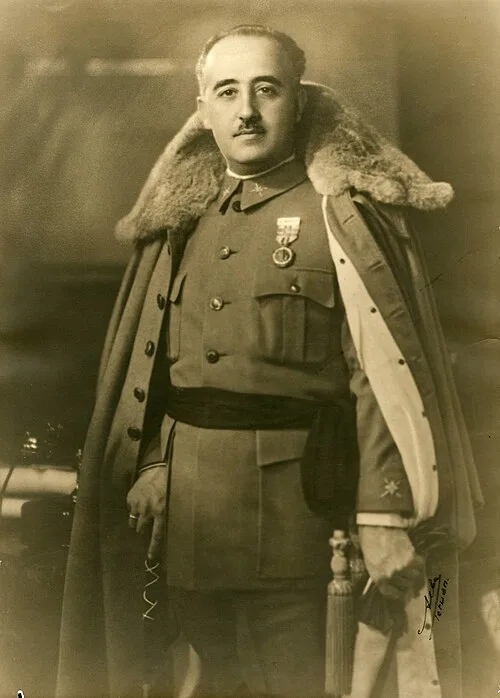
Francisco Franco
Franco CC0, Wikimedia Commons

After 1939 Franco (general and dictator) ruled a one-party state backed by the army, the Church and the Falange. Tens of thousands of Republicans were executed or died in prisons and camps, and hundreds of thousands lived in exile. Spain stayed out of the Second World War, though Franco sent a volunteer force, the Blue Division, to fight for Germany against the Soviet Union. Isolated at first, the regime won American support in the Cold War with the agreements of 1953 and joined the United Nations in 1955.

From 1959 economic reforms opened Spain up. Industry grew fast, millions of people moved to the cities or went to work in France and Germany, and foreign tourists poured into the coasts. The Basque separatist group ETA began a campaign of violence and in 1973 killed Franco’s prime minister, Admiral Luis Carrero Blanco. Franco died on 20 November 1975.

Franco (general and dictator) had chosen Juan Carlos (king who brought democracy), grandson of Alfonso XIII (king until 1931), as his successor. As king, Juan Carlos made Adolfo Suárez (prime minister of the transition) prime minister in 1976; parliament voted for reform, parties including the Communists were legalised, and free elections were held in 1977. The Constitution of 1978 made Spain a democratic parliamentary monarchy with self-governing regions. On 23 February 1981 civil guards led by Lieutenant Colonel Antonio Tejero (leader of the 1981 coup) stormed parliament, but the king spoke against the coup on television and it failed.

The Socialists under Felipe González (Socialist prime minister) governed from 1982 to 1996; Spain joined NATO in 1982 and the European Community in 1986, and Barcelona hosted the Olympic Games in 1992. In 2004 Islamist terrorists bombed Madrid commuter trains, killing 191 people. ETA ended its violence in 2011. A property crash after 2008 drove unemployment above 26 per cent. In 2017 Catalonia’s government held an independence referendum that the courts had banned and declared independence, and Madrid took direct control of the region for several months. Juan Carlos (king who brought democracy) abdicated in 2014 in favour of his son, Felipe VI (king of Spain since 2014), and Pedro Sánchez (Socialist prime minister) of the Socialists became prime minister in 2018.

Words worth knowing

Francoism

Franco’s dictatorship and its ideas: Catholic, nationalist, anti-communist and centralist.

Transition

The move from dictatorship to democracy between Franco’s death in 1975 and the early 1980s.

Autonomous community

One of the seventeen self-governing regions created under the Constitution of 1978.

ETA

Euskadi Ta Askatasuna, “Basque Homeland and Freedom”: a separatist group that killed more than 800 people from 1968 to 2010 and dissolved itself in 2018.

Did you know?

Why does Spain have a king again?

Franco (general and dictator) declared Spain a kingdom in 1947 and in 1969 named Juan Carlos (king who brought democracy) as his successor. Juan Carlos used the powers he inherited to bring in democracy.

When did Spain adopt the euro?

In 1999 for banking, and in 2002 for notes and coins, which replaced the peseta.

How many languages are official in Spain?

Spanish is official everywhere, and Catalan, Galician and Basque are also official in their own regions, as is Aranese, a form of Occitan, in Catalonia.

Myth or fact?

“The transition to democracy was entirely peaceful.”

Match the names

Tap a name, then the role that goes with it.

Check yourself

Question 1 of 3

When did Franco die?

Question 2 of 3

Which king spoke against the coup of 23 February 1981?

Question 3 of 3

When did Spain join the European Community?

Collect the seal

Answer all three questions above to stamp the Spain today seal. 0 of 3 answered.

Back to the seal book