Indian history in steps
Step 11 of 11

India today

1966 to today
Mat, “vote”

Indira Gandhi (prime minister) dominated India for almost two decades, winning a war that created Bangladesh but suspending democracy during the Emergency. Reforms in 1991 opened the economy and set off rapid growth. India today is the world’s most populous country and its largest democracy, a nuclear power with a space programme that has landed on the Moon.

About 6 minutes

Who you’ll meet

One key name in this era. Everyone else plays a smaller part: tap their name in the text whenever you need a reminder.

Also appearing (5)
Practise this era’s names

Where it happened

Tap a marker, a shaded region or a name below the map to see what happened there. Places in the text with a red pin open their own map card.

Region

Pakistan

India’s neighbour and rival, a nuclear power since 1998.

Coastlines from Natural Earth. Kingdoms, regions and today’s countries are shown by name only: several modern borders in South Asia are disputed, so none are drawn.

Open the atlas to compare this map with other eras, or browse all places.

What happened

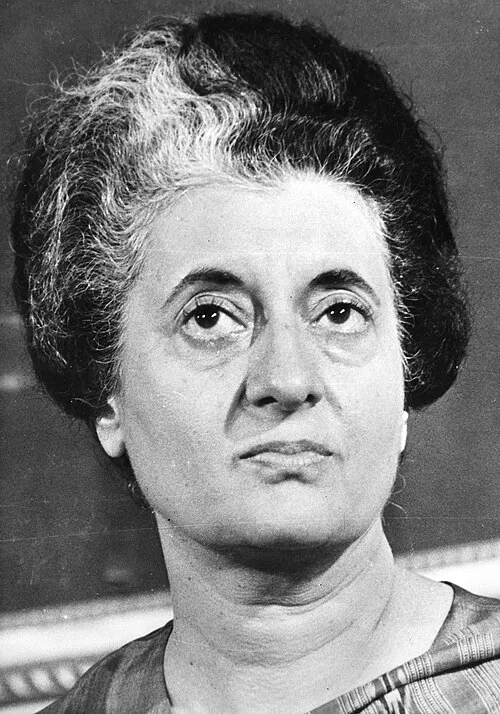
Indira Gandhi
Indira CC0, Wikimedia Commons

Indira Gandhi, Nehru’s daughter, became prime minister in 1966. New high-yield seeds, the Green Revolution, ended India’s dependence on food imports. In 1971 she backed the independence of East Pakistan, and after a short war it became Bangladesh. In 1974 India tested its first nuclear device.

In 1975, after a court found her guilty of electoral malpractice, Indira (prime minister) declared a state of emergency, jailed opponents and censored the press. When she called elections in 1977 she lost, but she returned in 1980. In 1984 she sent the army into the Golden Temple in Amritsar against armed Sikh separatists, and months later she was killed by two of her Sikh bodyguards, after which thousands of Sikhs were killed in riots. That December a gas leak at a pesticide factory in Bhopal killed thousands.

Her son Rajiv Gandhi (prime minister, Indira’s son) followed her and was himself assassinated in 1991 by a suicide bomber of the Tamil Tigers, a Sri Lankan rebel group. In the same year, facing a financial crisis, the government of Narasimha Rao (prime minister of the 1991 reforms) and his finance minister Manmohan Singh (economist and prime minister) scrapped many controls on business and opened India to foreign trade. In 1992 Hindu nationalists tore down the Babri mosque at Ayodhya, and riots followed.

Under Atal Bihari Vajpayee (BJP prime minister) India carried out nuclear tests in 1998, and Pakistan answered with its own. Manmohan Singh (economist and prime minister) led the country from 2004 to 2014, and Narendra Modi of the Hindu nationalist BJP has been prime minister since 2014, winning again in 2019 and, with the help of allies, in 2024. In 2023 India became the most populous country in the world and its Chandrayaan-3 craft landed near the Moon’s south pole.

Words worth knowing

Green Revolution

The spread of high-yield wheat and rice, fertiliser and irrigation from the late 1960s.

Emergency

The 21 months from June 1975 to March 1977 when Indira Gandhi ruled by decree.

Licence Raj

The system of permits needed to run or expand a business, largely dismantled after 1991.

Panchayat

An elected village council, given new powers by an amendment to the constitution in 1992.

Did you know?

How big is an Indian general election?

In 2024 about 970 million people could vote, and more than 640 million did, over six weeks, at about a million polling stations.

Has India had a woman prime minister?

One so far, Indira Gandhi (prime minister), who held the post from 1966 to 1977 and from 1980 to 1984.

What did Chandrayaan-3 do?

In August 2023 it made India the fourth country to land softly on the Moon, and the first to land near its south pole.

Myth or fact?

“India’s economy only began to grow after the reforms of 1991.”

Match the names

Tap a name, then the role that goes with it.

Check yourself

Question 1 of 3

Who was prime minister during the Emergency?

Question 2 of 3

In which year did the big economic reforms begin?

Question 3 of 3

Which country became independent after the war of 1971?

Collect the seal

Answer all three questions above to stamp the India today seal. 0 of 3 answered.

Back to the seal book