Indian history in steps
Step 1 of 11

The Indus civilisation

to c. 1300 BCE
Pura, “city” in Sanskrit

One of the world’s first civilisations grew up along the Indus and neighbouring rivers, in today’s Pakistan and north-west India. From about 2600 BCE its people built planned cities such as Harappa and Mohenjo-daro, with brick houses, drains and granaries, and used a script that no one can yet read. By about 1300 BCE the cities had been abandoned.

About 6 minutes

Who you’ll meet

Everyone in this era plays a smaller part: tap their name in the text whenever you need a reminder.

Also appearing (1)
Practise this era’s names

Where it happened

Tap a marker, a shaded region or a name below the map to see what happened there. Places in the text with a red pin open their own map card.

Place, c. 7000 BCE

Mehrgarh

One of the earliest farming villages in South Asia.

Coastlines from Natural Earth. Kingdoms, regions and today’s countries are shown by name only: several modern borders in South Asia are disputed, so none are drawn.

Open the atlas to compare this map with other eras, or browse all places.

What happened

Farming villages appeared in South Asia by about 7000 BCE; at Mehrgarh, in today’s Pakistan, people grew barley and wheat and kept cattle. Over the following millennia settlements spread across the plains of the Indus river and its tributaries, and along a river system to the east that is often identified with the Sarasvati of later texts, though that link is debated.

From about 2600 BCE, cities such as Harappa, Mohenjo-daro, Dholavira and Rakhigarhi were laid out with straight streets, baked bricks of standard sizes, wells, bathrooms and covered drains. Mohenjo-daro had a large waterproofed pool, the Great Bath. The civilisation covered a larger area than ancient Egypt or Mesopotamia, yet archaeologists have found no palace or royal tomb, and how it was ruled is unknown.

Its people traded with Mesopotamia, whose texts mention a land called Meluhha, probably the Indus region. They used standard stone weights and carved thousands of small square seals with animals, such as a one-horned bull, and short inscriptions. The Indus script has never been deciphered, partly because the inscriptions are so short and no bilingual text has been found.
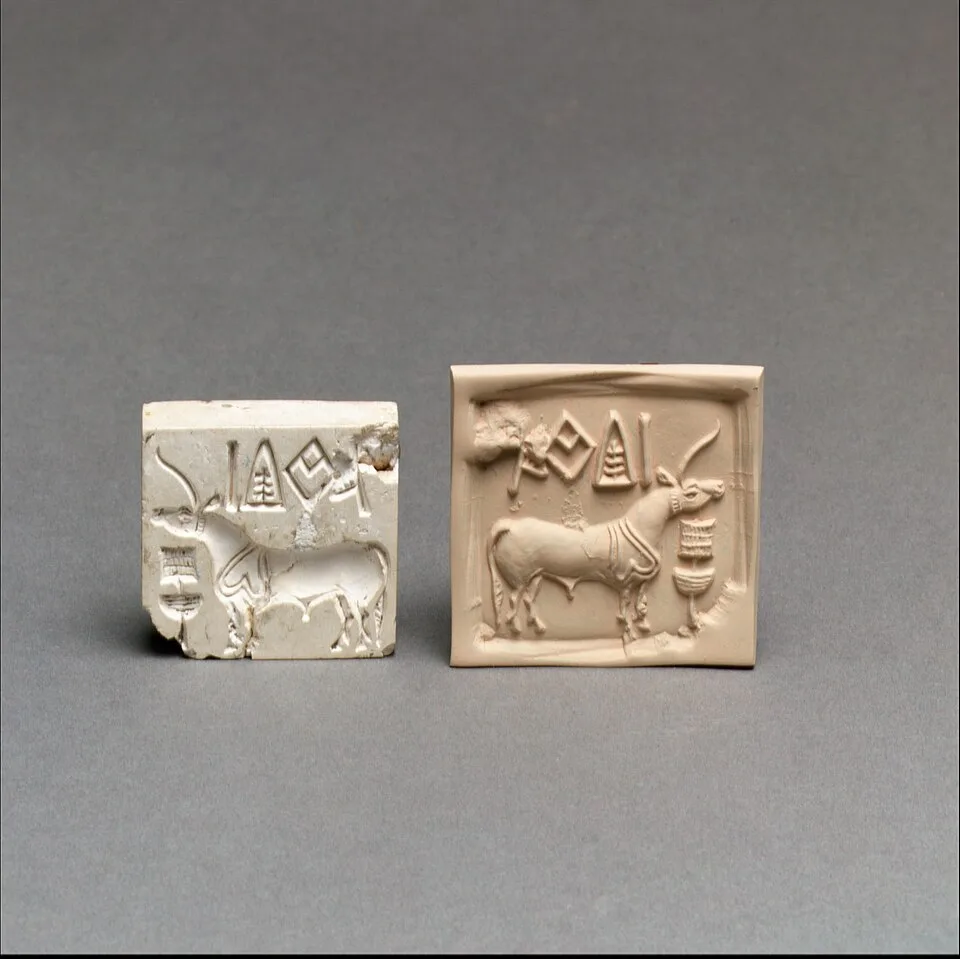
Indus stamp seal with a one-horned animal and a short inscription, beside a modern impression of it, around 2600–1900 BCE. Metropolitan Museum of Art, New York.
Indus stamp seal with a one-horned animal and a short inscription, beside a modern impression of it, around 2600–1900 BCE. Metropolitan Museum of Art, New York. CC0, via Wikimedia Commons

From about 1900 BCE the cities declined and were gradually abandoned. Historians point to shifts in the monsoon, rivers changing course or drying up, and the decline of trade with Mesopotamia; the old theory of an invasion is no longer widely held. Village life went on, and the cities were forgotten until archaeologists began digging at Harappa in 1921.

Words worth knowing

Harappan

Another name for the Indus civilisation, after Harappa, the first of its cities to be excavated.

Great Bath

A large brick pool at Mohenjo-daro, sealed with bitumen, perhaps used for ritual bathing.

Citadel

The raised, walled part of many Indus cities, set apart from the lower town.

Meluhha

A land named in Mesopotamian texts as a source of goods such as carnelian, ivory and timber, probably the Indus region.

Did you know?

How big was Mohenjo-daro?

It covered more than 200 hectares and may have had tens of thousands of people, making it one of the largest cities of its time.

Did the Indus people have bathrooms?

Many houses had a bathing area, and some had toilets, connected to covered brick drains that ran along the streets.

What is on the Indus seals?

Most show an animal, most often a bull with a single horn, with a short line of signs above it. Seals have been found as far away as Mesopotamia.

Myth or fact?

“The Indus cities were destroyed by Aryan invaders.”

Check yourself

Question 1 of 3

Which Indus city has the Great Bath?

Question 2 of 3

When did archaeologists begin digging at Harappa?

Question 3 of 3

Why can no one read the Indus script?

Collect the seal

Answer all three questions above to stamp the Indus seal. 0 of 3 answered.

Back to the seal book