Indian history in steps
Step 4 of 11

Classical India: the Guptas and the south

c. 185 BCE – 550 CE
Kavi, “poet”

After the Mauryas, the north was ruled by many dynasties, including invaders from Central Asia such as the Kushans, while the south grew rich on trade with Rome. From the 4th century CE the Gupta kings ruled the north in an age remembered for Sanskrit poetry, sculpture, mathematics and astronomy, including the place-value numerals with zero that later spread to the world.

About 6 minutes

Who you’ll meet

2 key names in this era. Everyone else plays a smaller part: tap their name in the text whenever you need a reminder.

Also appearing (5)

Families in this step: The Mauryas The Guptas The Cholas

Practise this era’s names

Where it happened

Tap a marker, a shaded region or a name below the map to see what happened there. Places in the text with a red pin open their own map card.

Region

Gandhara

Where Buddhist art mixed Indian and Greek styles.

Coastlines from Natural Earth. Kingdoms, regions and today’s countries are shown by name only: several modern borders in South Asia are disputed, so none are drawn.

Open the atlas to compare this map with other eras, or browse all places.

What happened

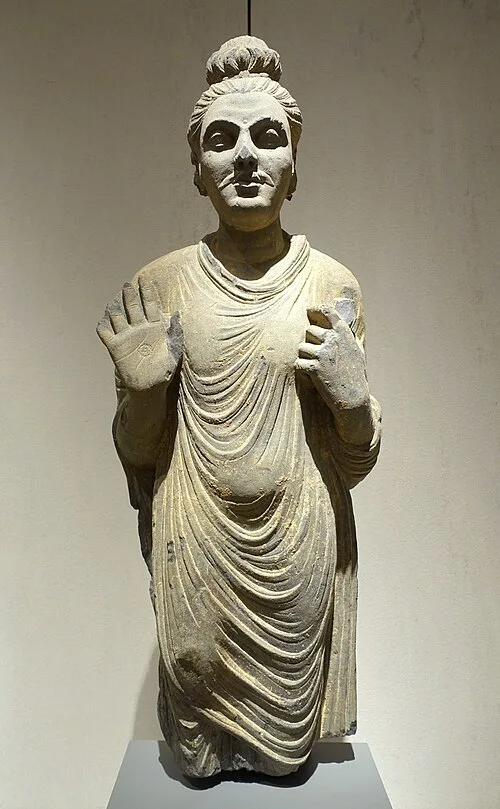
The Buddha
Buddha CC0, Wikimedia Commons

After 185 BCE northern India was divided. Indo-Greek kings ruled the north-west, and the Kushans, from Central Asia, built an empire stretching from Afghanistan into the Ganges plain; their king Kanishka (Kushan emperor), in the 2nd century CE, supported Buddhism. Under Kushan rule, artists in Gandhara and Mathura made some of the first images of the Buddha (founder of Buddhism) in human form.

In the south, Tamil kingdoms, the Cheras, Cholas and Pandyas, appear in the poems of the Sangam literature. Roman ships sailed with the monsoon winds to ports such as Muziris, on the Malabar coast, to buy pepper, and Roman coins have been found in large numbers in southern India.

The Gupta dynasty rose in Magadha in the 4th century CE. Samudragupta (Gupta conqueror) led campaigns across much of the subcontinent, and his son Chandragupta II (Gupta emperor) extended the empire to the west. The Chinese monk Faxian (Chinese pilgrim monk), who visited in the early 5th century, described a peaceful and prosperous land. The poet and playwright Kalidasa (Sanskrit poet) probably wrote in this period.

Scholars of the age made lasting advances. Aryabhata (mathematician and astronomer), in 499, wrote on astronomy and mathematics, using a place-value system, giving a value for pi and explaining eclipses. Indian mathematicians developed the decimal numerals, with zero, that later passed through the Arab world to Europe. In the late 5th and 6th centuries invasions by the Huns from Central Asia weakened the Guptas, and their empire broke up.

Words worth knowing

Sangam

“Assembly”: the earliest Tamil poetry, said to have been composed at gatherings of poets in Madurai.

Gandhara art

Buddhist sculpture of the north-west, mixing Indian and Greek styles.

Place-value notation

Writing numbers with ten digits whose value depends on their position, with zero marking an empty place.

Shunya

“Empty”: the Sanskrit word for zero, translated into Arabic as sifr, from which come the English words zero and cipher.

Did you know?

Why are our numbers called Arabic?

Europeans learned them from the books of Arab mathematicians, which were translated into Latin from the 12th century. Arab writers themselves called them Indian numerals.

Why did Faxian come to India?

To find and copy Buddhist scriptures. He set out from China across Central Asia in 399 and went home by sea in 412, and his account of his travels survives.

What is the Iron Pillar of Delhi?

A pillar of wrought iron about 7 metres tall, with an inscription of the Gupta age naming a king called Chandra, which has resisted rust for some 1,600 years. It stands in the Qutb complex in Delhi.

Myth or fact?

“India invented zero.”

Match the names

Tap a name, then the role that goes with it.

Check yourself

Question 1 of 3

Which dynasty ruled northern India in its classical age from the 4th century CE?

Question 2 of 3

What did Roman traders mostly buy in southern India?

Question 3 of 3

Who wrote on astronomy and mathematics in 499?

Collect the seal

Answer all three questions above to stamp the Classical age seal. 0 of 3 answered.

Back to the seal book