Japanese history in steps
Step 8 of 11

Edo

1603 – 1868
Edo, today’s Tokyo

The Tokugawa shoguns gave Japan more than 250 years of peace under tight rules: lords on a short leash, a fixed social order and contact with the outside world limited to a few controlled channels. Cities boomed, and a lively popular culture of kabuki, woodblock prints and haiku was born.

About 6 minutes

Who you’ll meet

2 key names in this era. Everyone else plays a smaller part: tap their name in the text whenever you need a reminder.

Also appearing (4)

Family in this step: Tokugawa

Practise this era’s names

Where it happened

Tap a marker, a shaded region or a name below the map to see what happened there. Places in the text with a red pin open their own map card.

Pacific Ocean

Seat of power

Edo

Seat of the Tokugawa shoguns and, by the 18th century, a city of perhaps a million people. Perry’s black ships anchored in Edo Bay in 1853.

Coastlines from Natural Earth; prefecture shapes from Global Map Japan (GSI). Shaded regions follow today’s boundaries as a guide.

Open the atlas to compare this map with other eras, or browse all places.

What happened

The Tokugawa shogunate ruled from Edo, today’s Tokyo. Under alternate attendance, each daimyo spent every other year in Edo, and his wife and heir lived there permanently. The cost of the processions and two households kept the lords busy, short of money and loyal.

From the 1630s the shogunate banned Christianity, forbade Japanese to travel abroad and allowed only the Dutch among Europeans to trade, confined to the small artificial island of Dejima in Nagasaki harbour. Trade continued with China, Korea, the Ryukyu kingdom and the Ainu through tightly controlled routes.
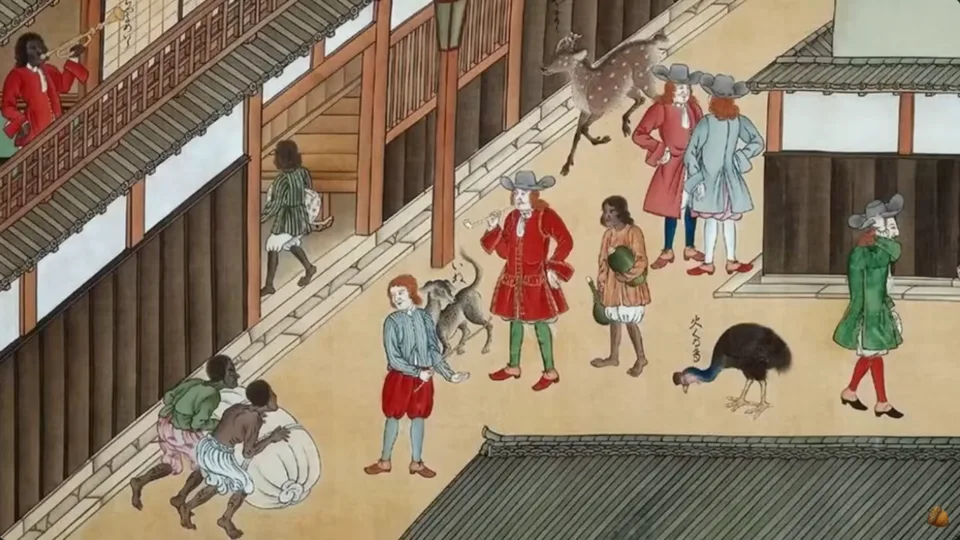
Dutch traders on Dejima, by Watanabe Shūseki (1639–1707).
Dutch traders on Dejima, by Watanabe Shūseki (1639–1707). CC0, via Wikimedia Commons
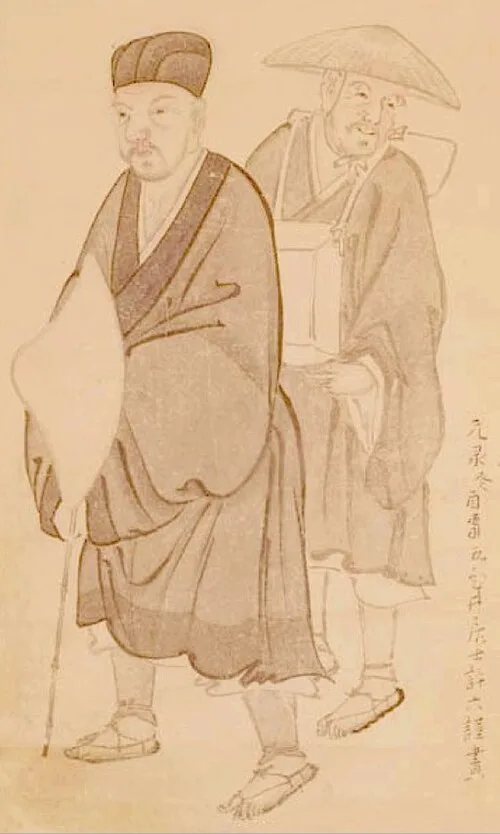
Matsuo Bashō
Bashō Public domain, Wikimedia Commons

Peace let cities grow. By the 18th century Edo probably had around a million people, one of the largest cities in the world. Merchants were officially at the bottom of the social order but grew rich, and they paid for a new urban culture: kabuki theatre, ukiyo-e woodblock prints and the poetry of Matsuo Bashō (haiku poet).
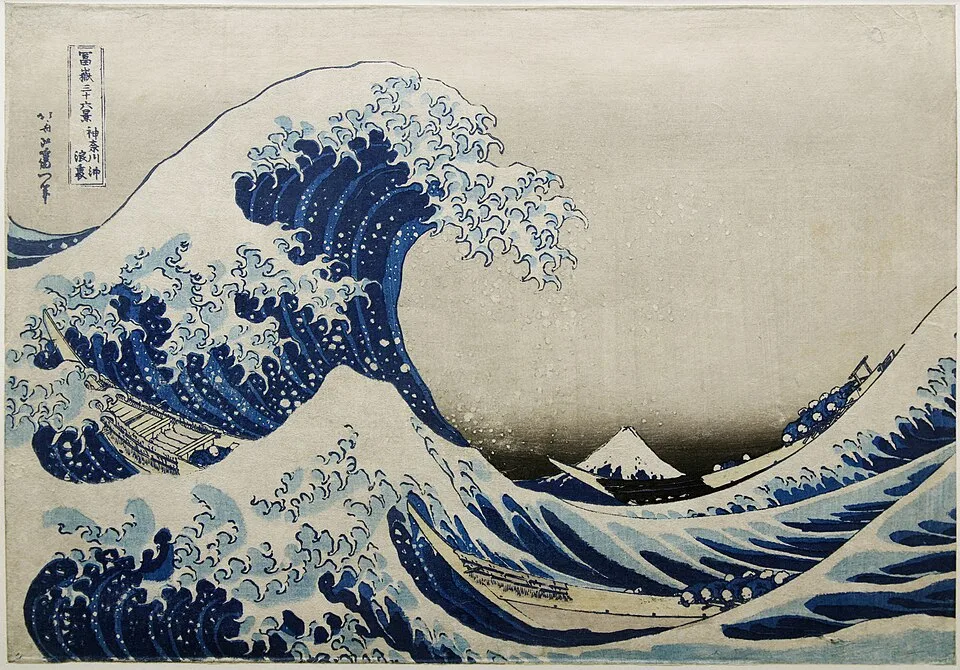
Under the Wave off Kanagawa, known as the Great Wave, by Katsushika Hokusai, 1831. British Museum.
Under the Wave off Kanagawa, known as the Great Wave, by Katsushika Hokusai, 1831. British Museum. Public domain, via Wikimedia Commons
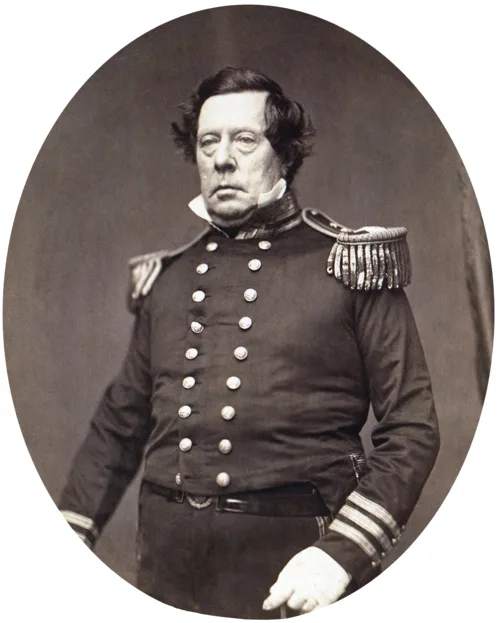
Matthew Perry
Perry Public domain, Wikimedia Commons

In 1853 four American warships under Commodore Matthew Perry (US commodore of the black ships) entered Edo Bay and demanded that Japan open its ports. The shogunate signed a treaty in 1854 and more unequal treaties in 1858. Many samurai, especially from the Satsuma and Chōshū domains, saw the shogunate as weak, and in 1867 the last shogun, Tokugawa Yoshinobu, handed power back to the emperor.
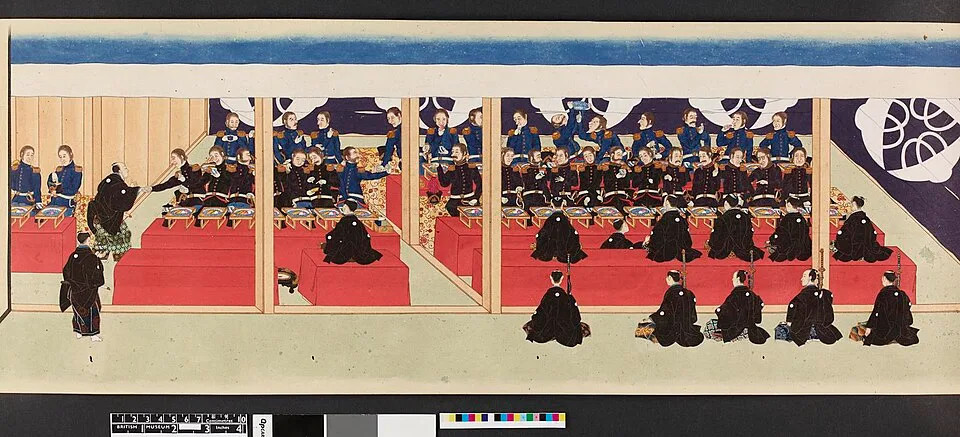
From a Japanese handscroll recording Perry’s second visit in 1854, painted by Hibata Ōsuke, 1854–1858. British Museum.
From a Japanese handscroll recording Perry’s second visit in 1854, painted by Hibata Ōsuke, 1854–1858. British Museum. Public domain, via Wikimedia Commons

Words worth knowing

Sankin-kōtai

“Alternate attendance”: the rule that lords spend alternate years in Edo.

Sakoku

“Closed country”: the later name for the shogunate’s policies limiting foreign contact.

Ukiyo-e

“Pictures of the floating world”: woodblock prints of actors, beauties, landscapes and city life.

Rangaku

“Dutch learning”: European science and medicine studied through Dutch books.

Chōnin

Townspeople, the merchants and artisans who drove Edo’s popular culture.

Did you know?

Who invented kabuki?

Its origin is usually traced to a woman, Izumo no Okuni (founder of kabuki), who performed in Kyoto around 1603. The shogunate banned women from the stage in 1629, and kabuki has been performed by all-male casts ever since.

Who coined the word “sakoku”?

A Japanese translator, in 1801, while translating a book by Engelbert Kaempfer (German doctor at Dejima), a German doctor who had worked at Dejima. The people who made the policies never used the word.

Why is The Great Wave so blue?

Hokusai’s print (around 1831) uses Prussian blue, a synthetic pigment imported from Europe that had recently become affordable in Japan. Prints like it fascinated European artists; Debussy put The Great Wave on the cover of his score La Mer.

Myth or fact?

“Japan was completely sealed off from the outside world for more than 200 years.”

Match the names

Tap a name, then the role that goes with it.

Check yourself

Question 1 of 3

What was alternate attendance (sankin-kōtai)?

Question 2 of 3

Which Europeans were allowed to trade during the closed-country era?

Question 3 of 3

Who forced Japan to open its ports in 1853–54?

Collect the seal

Answer all three questions above to stamp the Edo seal. 0 of 3 answered.

Back to the seal book