The 1910s and 1920s brought party politics and mass culture. The 1930s brought economic crisis, military dominance and expansion in Asia, ending in the Pacific War, the atomic bombings and Japan’s surrender in 1945.
About 6 minutes
Who you’ll meet
One key name in this era. Everyone else plays a smaller part: tap their name in the text whenever you need a reminder.
Tap a marker, a shaded region or a name below the map to see what happened there. Places in the text with a red pin open their own map card.
Pacific OceanChina
Seat of power
Tokyo 東京
The 1923 earthquake devastated Tokyo and nearby Yokohama. The air raid of March 1945 burned much of the city, and the surrender was signed in Tokyo Bay on 2 September 1945.
Coastlines from Natural Earth; prefecture shapes from Global Map Japan (GSI). Shaded regions follow today’s boundaries as a guide.
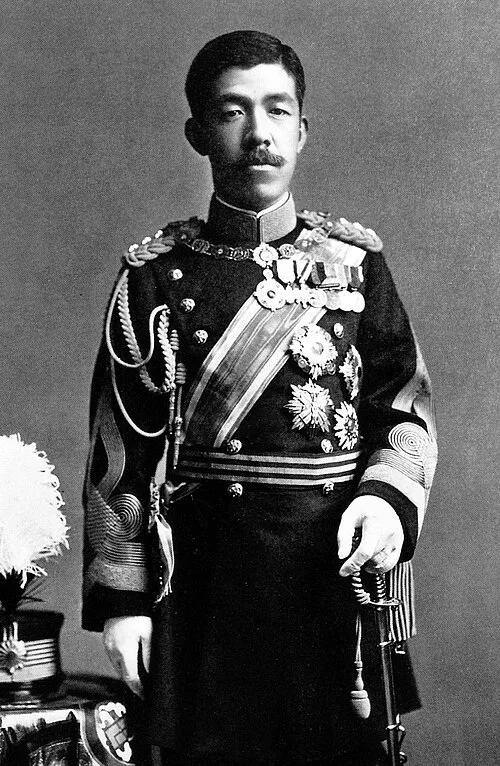
Under Emperor Taishō(Meiji’s son) (1912–1926), political parties gained ground, and in 1925 all men aged 25 and over won the vote, in the same year that a Peace Preservation Law gave police sweeping powers against radicals. Japan fought on the Allied side in World War I and sat among the victors at the 1919 Paris Peace Conference.
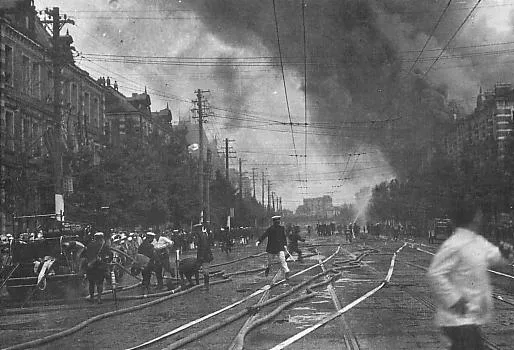
On 1 September 1923 the Great Kantō earthquake and the fires that followed killed more than 100,000 people in and around Tokyo and Yokohama. In the chaos, vigilantes, at times joined by police and soldiers, murdered thousands of Koreans after false rumours spread.
Marunouchi, Tokyo, after the Great Kantō earthquake, 1 September 1923. Public domain, via Wikimedia Commons
After the Depression struck, army officers increasingly acted on their own. In 1931 officers staged an incident in Manchuria as a pretext to seize the region, and Japan left the League of Nations in 1933 after being condemned. Full-scale war with China began in 1937, including the mass killing of civilians and prisoners at Nanjing. In December 1941 Japan attacked the US fleet at Pearl Harbor and moved against American, British and Dutch territories across Southeast Asia.
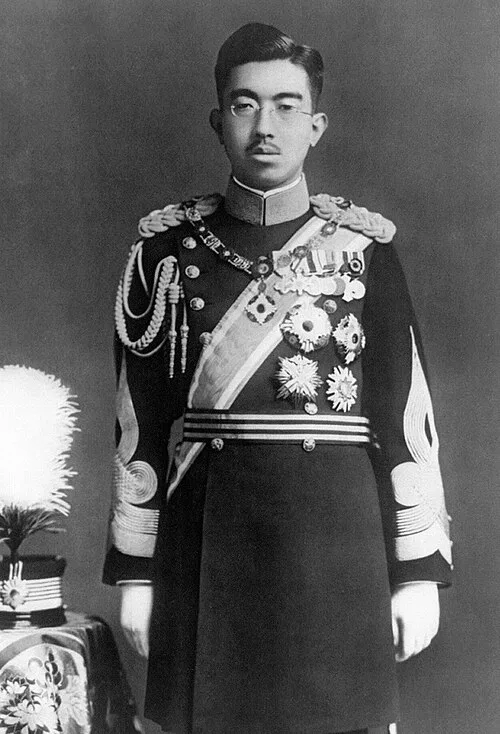
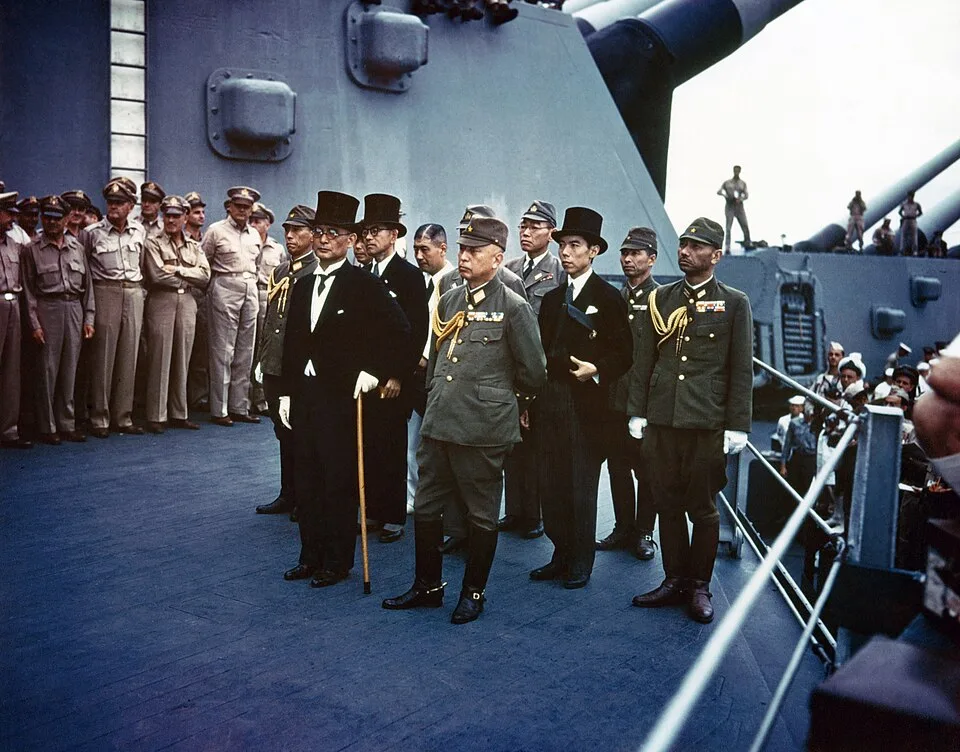
After early victories, the tide turned at Midway in June 1942. By 1945 American bombing had burned most major cities; the Tokyo raid of 9–10 March alone killed an estimated 100,000 people. Atomic bombs destroyed Hiroshima on 6 August and Nagasaki on 9 August, and the Soviet Union declared war on 8 August. Estimates of deaths in the two bombed cities by the end of 1945 range from about 130,000 to over 200,000. On 15 August Emperor Hirohito(emperor of the war years) announced surrender by radio, and the formal surrender was signed on 2 September 1945.
Japan’s representatives on board USS Missouri for the surrender ceremony in Tokyo Bay, 2 September 1945. US Army Signal Corps. Public domain, via Wikimedia Commons
Words worth knowing
Taishō democracy大正デモクラシー
The 1910s–20s, when party cabinets, newspapers and mass movements flourished.
Manchukuo満州国
The puppet state Japan set up in Manchuria in 1932.
Gyokuon-hōsō玉音放送
“Jewel voice broadcast”: the emperor’s recorded surrender announcement of 15 August 1945.
Hibakusha被爆者
Survivors of the atomic bombings.
Did you know?
What did Japan propose at the 1919 peace conference?
A clause on racial equality in the League of Nations Covenant. A majority of the commission voted for it, but US President Woodrow Wilson, as chair, ruled that it needed unanimous support, and it was dropped.
Why was the surrender broadcast so startling?
Most Japanese had never heard the emperor’s voice. The recorded speech, in formal court language, was hard for many listeners to follow, and it never used the word “surrender”.
Why are paper cranes a symbol of peace?
Sadako Sasaki(girl of the paper cranes) was two when the bomb fell on Hiroshima. She developed leukaemia and folded paper cranes in hospital before dying in 1955, aged 12. The Children’s Peace Monument in Hiroshima, inspired by her story, is often hung with cranes sent from around the world.
Myth or fact?
“A Japanese soldier kept fighting in the Philippine jungle until 1974.”
Match the names
Tap a name, then the role that goes with it.
Check yourself
Question 1 of 3
On which side did Japan fight in World War I?
Question 2 of 3
What happened in Manchuria in 1931?
Question 3 of 3
On what date did the emperor announce Japan’s surrender by radio?
大正昭和
Collect the seal
Answer all three questions above to stamp the Taishō–Shōwa seal. 0 of 3 answered.