Idea, as in the Megali Idea, the “Great Idea” of uniting all Greeks
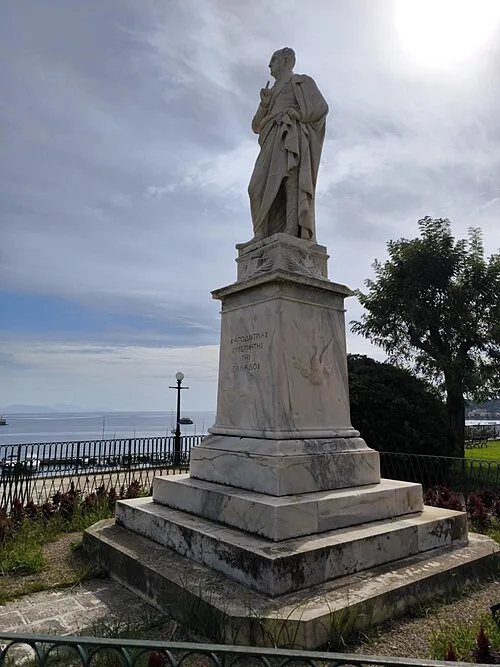
In 1821 the Greeks rose against Ottoman rule. After years of war and massacres on both sides, the great powers stepped in, and in 1830 Greece became an independent state, small and poor. Its first governor, Kapodistrias(first governor of Greece), was murdered, and a Bavarian prince became King Otto(first king of Greece). Over the next century Greece grew, driven by the “Great Idea”, and grew by about two-thirds in the Balkan Wars of 1912–13.
About 6 minutes
Who you’ll meet
3 key names in this era. Everyone else plays a smaller part: tap their name in the text whenever you need a reminder.
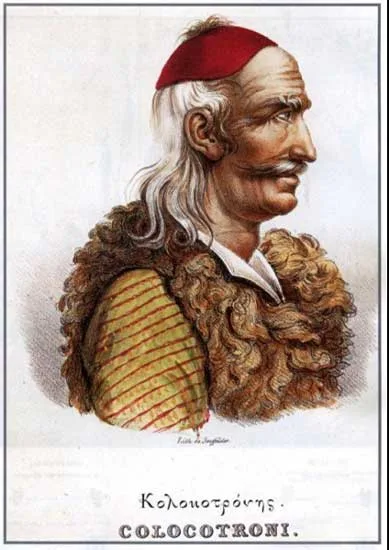
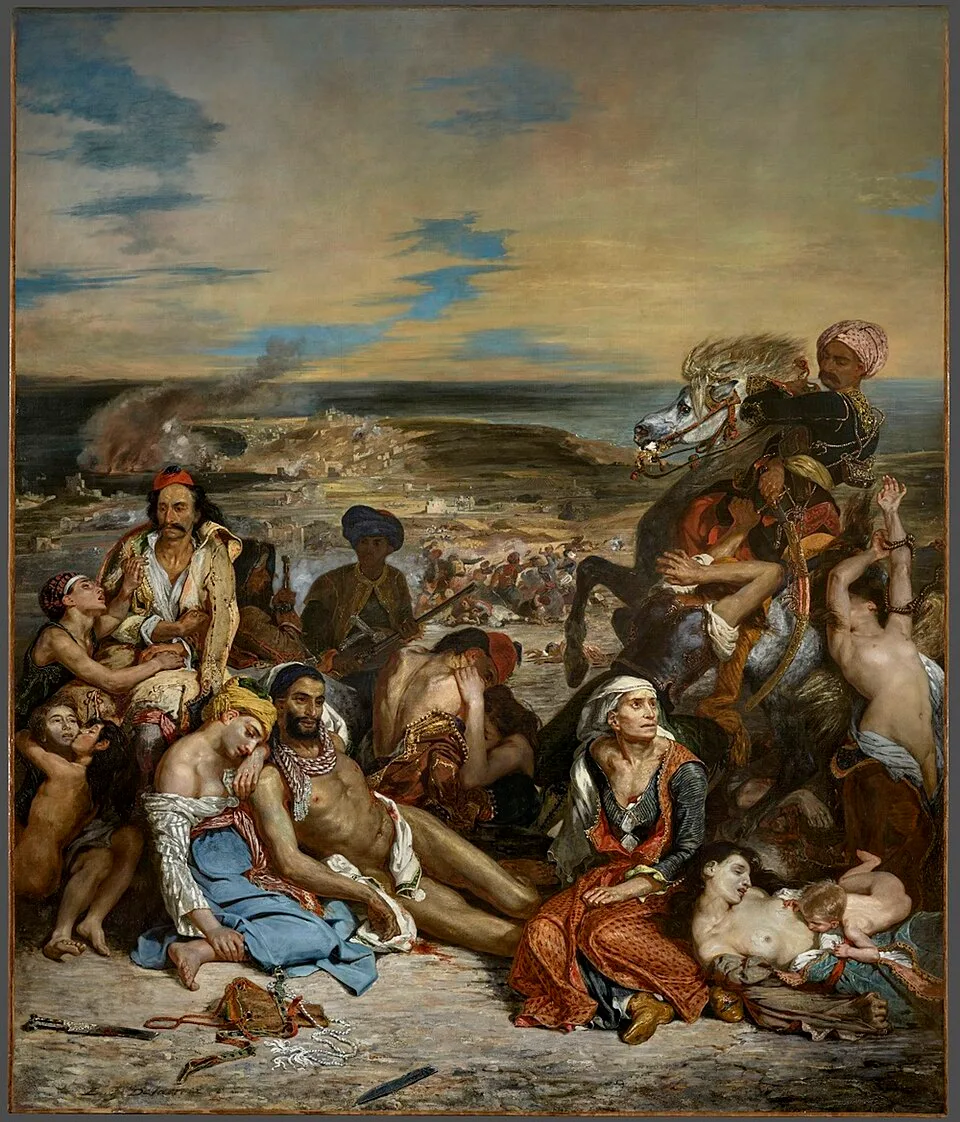
In early 1821 Alexandros Ypsilantis, leader of the Filiki Eteria, crossed into Moldavia, and soon the Peloponnese rose up; Greeks celebrate 25 March as Independence Day. Fighters led by Theodoros Kolokotronis(general of the revolution) took Tripolitsa that autumn and killed thousands of its Muslim and Jewish inhabitants. The Ottomans answered with massacres too, most terribly on Chios in 1822.
The Massacre at Chios by Eugène Delacroix, 1824. Louvre, Paris. Public domain, via Wikimedia Commons
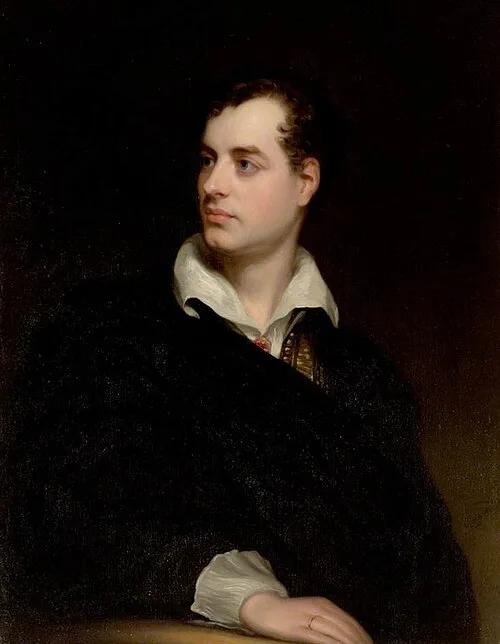
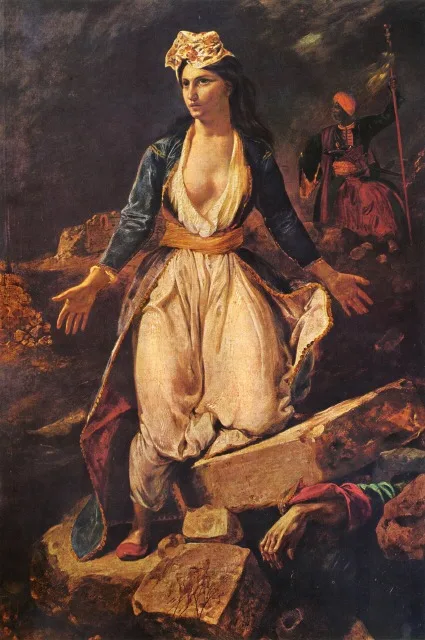
The Greeks quarrelled among themselves, while volunteers came from Europe; the poet Lord Byron(English poet and philhellene) died of fever at Missolonghi in 1824. Egyptian troops under Ibrahim Pasha(Egyptian commander in Greece) almost crushed the revolt, and Missolonghi fell in 1826. In 1827 the fleets of Britain, France and Russia destroyed the Ottoman and Egyptian fleet at Navarino, and in 1830 Greece was recognised as independent.
Greece on the Ruins of Missolonghi by Eugène Delacroix, 1826. Public domain, via Wikimedia Commons
Its first governor, Ioannis Kapodistrias(first governor of Greece), a former foreign minister of Russia, was murdered in 1831 by members of a rival family. The powers then made the teenage Otto(first king of Greece) of Bavaria king, and Athens, then a small town, became the capital in 1834. A revolt in 1843 forced Otto to grant a constitution, remembered in the name of Syntagma Square, “Constitution Square”; another in 1862 drove him out, and a Danish prince became King George I(king of Greece for fifty years).
Greeks dreamed of the Megali Idea, the “Great Idea” of uniting all Greeks in one state with Constantinople as its capital. Britain handed over the Ionian Islands in 1864, and Thessaly followed in 1881. Under Charilaos Trikoupis(prime minister who modernised Greece) the country built railways and cut the Corinth Canal, opened in 1893, but went bankrupt the same year. In the Balkan Wars of 1912–13, with Eleftherios Venizelos(statesman of the Balkan Wars) as prime minister, Greece won Macedonia, including Thessaloniki, as well as Epirus and many islands, and Crete joined it in 1913.
Words worth knowing
Megali IdeaΜεγάλη Ιδέα
The “Great Idea”: the goal of uniting all Greek-inhabited lands in one state, with Constantinople as its capital. It shaped Greek politics until 1922.
Philhelleneφιλέλληνας
A foreign “friend of the Greeks” who supported the revolution with money, writing or by fighting. The most famous was Lord Byron.
SyntagmaΣύνταγμα
“Constitution”. Athens’ central square is named after the constitution King Otto granted in 1844, after the revolt of 3 September 1843.
Kodjabashiκοτζαμπάσης
A Christian notable of the Peloponnese who collected taxes for the Ottomans. Many joined the revolution and later clashed with its military leaders.
Did you know?
Why does Greece celebrate independence on 25 March?
The date, chosen later, is also the Feast of the Annunciation. Tradition says Bishop Germanos of Patras(bishop of the revolution) raised the banner of revolution at the monastery of Agia Lavra that day, though historians doubt it happened just so.
Where does the Greek national anthem come from?
It is the opening of the Hymn to Liberty, a poem of 158 verses written in 1823 by Dionysios Solomos(national poet of Greece) of Zakynthos. It became the national anthem in 1865, and usually only the first two verses are sung.
How did Lord Byron die?
Of a fever at Missolonghi in April 1824, aged 36, before he had seen any fighting. Greeks honoured him as a hero, and Vyronas, a district of Athens, is named after him.
Myth or fact?
“The nine stripes of the Greek flag stand for the nine syllables of “Eleftheria i thanatos”, “Freedom or death”.”
Match the names
Tap a name, then the role that goes with it.
Check yourself
Question 1 of 3
Which naval battle of 1827 decided the war of independence?
Question 2 of 3
Who was the first king of Greece?
Question 3 of 3
Which city did Greece win in the Balkan Wars of 1912–13?
ΙΔΕΑ
Collect the seal
Answer all three questions above to stamp the Independence seal. 0 of 3 answered.