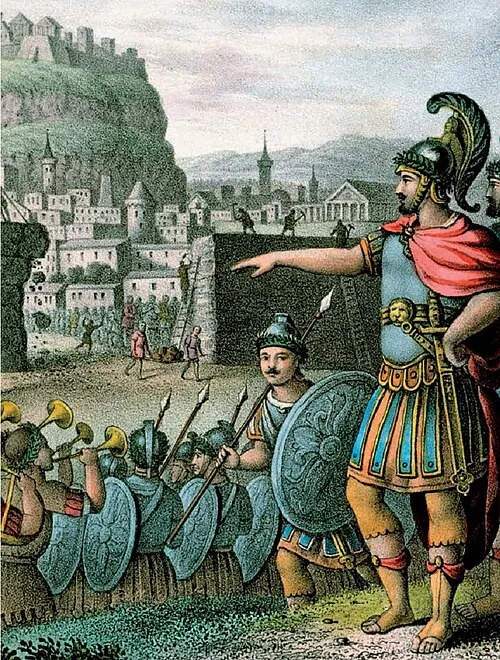
Twice the Persian Empire invaded Greece, and twice an alliance of city-states drove it back, at Marathon in 490 BCE and at Salamis and Plataea in 480–479 BCE. Athens became an imperial power and a centre of democracy, drama, philosophy and building, crowned by the Parthenon. Then it fought a long war with Sparta and lost it in 404 BCE.
About 6 minutes
Who you’ll meet
4 key names in this era. Everyone else plays a smaller part: tap their name in the text whenever you need a reminder.
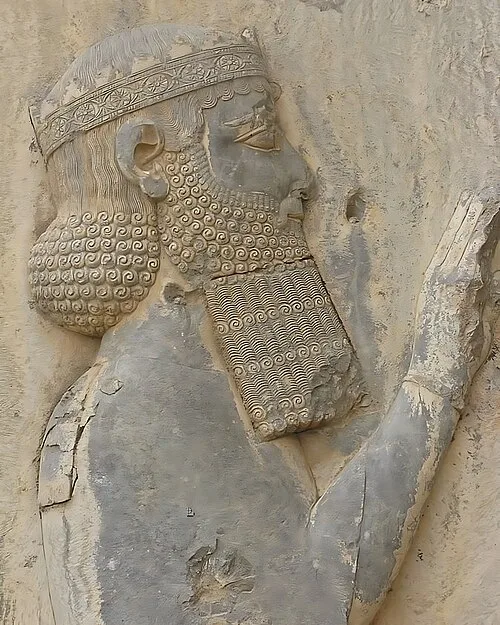
In 490 BCE King Darius I(Persian king who sent the army to Marathon) of Persia sent a fleet to punish Athens for helping the Ionian revolt. Its army landed at Marathon, where the Athenians and their allies from Plataea defeated it. Ten years later Darius’s son Xerxes(Persian king who invaded Greece) came with a far larger army and fleet. At the pass of Thermopylae, King Leonidas(Spartan king who died at Thermopylae) of Sparta and a few thousand Greeks held him off for three days; Leonidas and his 300 Spartans, with hundreds of other Greeks, died there.
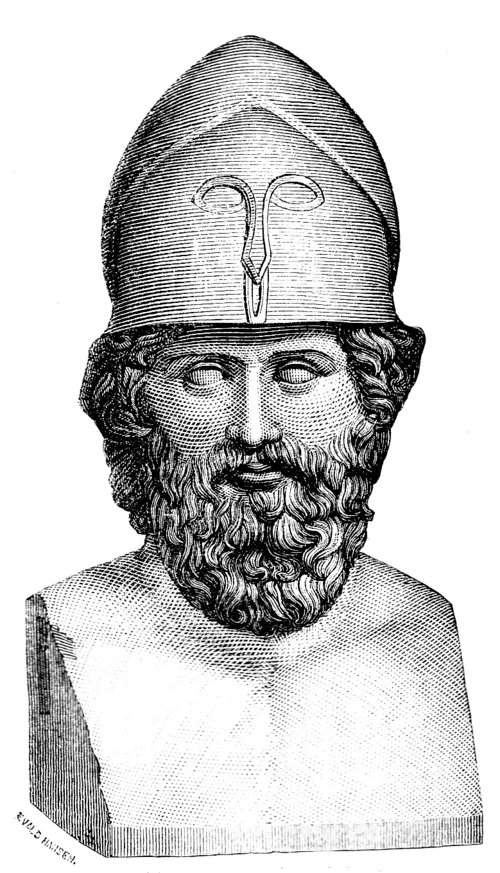
Xerxes(Persian king who invaded Greece) burned Athens, whose people had fled to Salamis and other places. But in the narrow strait of Salamis, in 480 BCE, the Greek fleet, built on the advice of the Athenian Themistocles(Athenian who built the fleet), destroyed much of the Persian fleet. In 479 BCE the Greeks won on land at Plataea, led by the Spartan Pausanias(Spartan commander at Plataea), and Persia never invaded mainland Greece again.
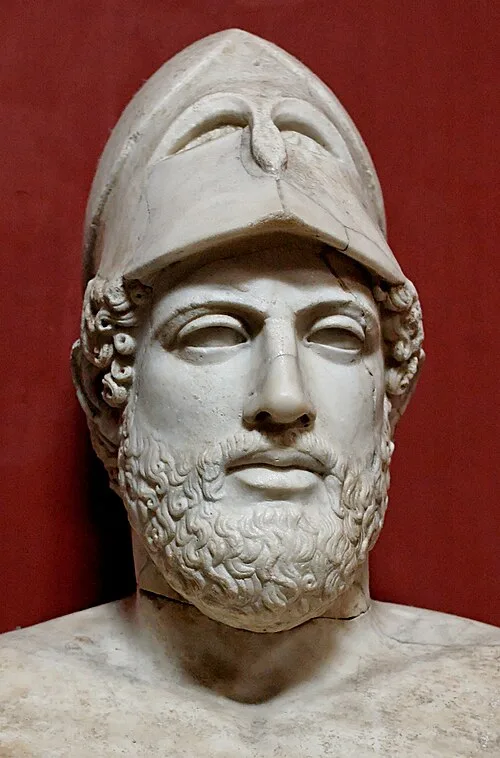
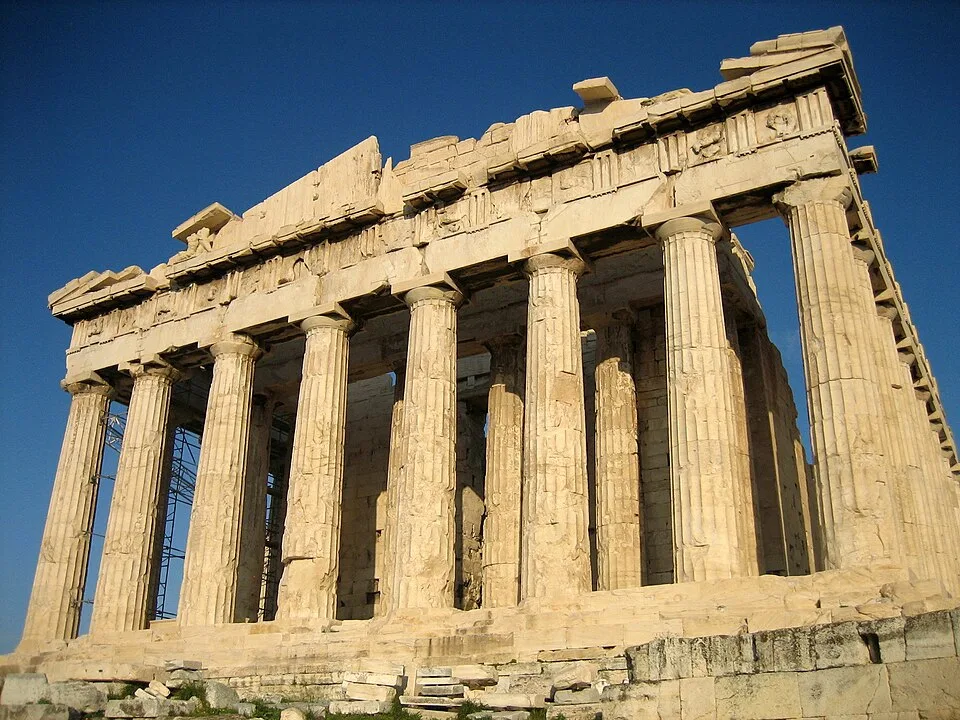
Athens led a league of allies, called the Delian League after its first treasury on Delos, to carry on the war at sea. Over time it turned the league into an empire, moving the treasury to Athens in 454 BCE. Under the leadership of Pericles(leader of Athens in its golden age), the money helped pay for the Parthenon, built between 447 and 432 BCE. Athens was also home to the tragedies of Aeschylus(first of the great tragedians), Sophocles(tragedian of Oedipus) and Euripides(tragedian of Medea), the comedies of Aristophanes(comic playwright of Athens), the histories of Herodotus(first historian of the Greeks) and Thucydides(historian of the Peloponnesian War), and the questioning of Socrates(Athenian philosopher).
The Parthenon from the west, photographed in 2006. Public domain, via Wikimedia Commons
Sparta and its allies feared Athens’ power, and the Peloponnesian War broke out in 431 BCE. A plague struck crowded Athens in 430 and killed Pericles(leader of Athens in its golden age) the next year. In 415 Athens sent a great expedition to Sicily, which was destroyed in 413. Sparta, now paid by Persia, built a fleet, and after its admiral Lysander(Spartan admiral who beat Athens) destroyed the Athenian fleet at Aegospotami in 405, Athens surrendered in 404 BCE.
Words worth knowing
Triremeτριήρης
A warship rowed by about 170 oarsmen in three rows, with a bronze ram at the bow. In Athens the rowers were mostly poorer citizens, which gave them a strong voice in the democracy.
Democracyδημοκρατία
“Power of the people”: in Athens, direct rule by the assembly of adult male citizens, who voted on laws, war and peace themselves.
Ostracismοστρακισμός
A yearly vote in which Athenians could send one man into exile for ten years by scratching his name on a potsherd, an ostrakon. He kept his property and could come back afterwards.
Acropolisακρόπολις
“High city”: the fortified hilltop at the heart of a Greek city. The Acropolis of Athens holds the Parthenon.
Did you know?
How many Greeks fought at Thermopylae?
Leonidas(Spartan king who died at Thermopylae) brought 300 Spartan citizens, but the whole Greek force numbered several thousand at first. On the last day some 700 men of Thespiae stayed and died with the Spartans, and a group of Thebans who stayed with them surrendered.
Were Athenian plays like plays today?
They were staged at festivals of the god Dionysus, in open-air theatres seating thousands. All the actors were men and wore masks, and a chorus sang and danced between the scenes.
How did Socrates die?
In 399 BCE an Athenian jury found him guilty of disrespecting the city’s gods and corrupting the young, and he was put to death by drinking hemlock. He wrote nothing himself; we know him mainly through his pupils Plato(philosopher, founder of the Academy) and Xenophon(soldier and writer, pupil of Socrates).
Myth or fact?
“Greek temples and statues were meant to be pure white marble.”
Match the names
Tap a name, then the role that goes with it.
Check yourself
Question 1 of 3
Where did the Athenians defeat the first Persian invasion in 490 BCE?
Question 2 of 3
Which Spartan king held the pass of Thermopylae?
Question 3 of 3
Who won the Peloponnesian War?
ΝΙΚΗ
Collect the seal
Answer all three questions above to stamp the Classical Greece seal. 0 of 3 answered.