Greek history in steps
Step 2 of 11

The Dark Age and Archaic Greece

c. 1100–490 BCE
Agōn, “contest”, as in the games at Olympia

After the palaces fell, Greece became poorer and quieter for centuries. From the 8th century BCE it revived: the Greeks took up the alphabet, Homer’s epics were composed, the Olympic Games began, and hundreds of independent city-states sent settlers across the Mediterranean and the Black Sea. Athens and Sparta took the different paths that would shape the next age.

About 6 minutes

Who you’ll meet

One key name in this era. Everyone else plays a smaller part: tap their name in the text whenever you need a reminder.

Also appearing (4)
Practise this era’s names

Where it happened

Tap a marker, a shaded region or a name below the map to see what happened there. Places in the text with a red pin open their own map card.

Seat of power

Athens

Reformed by Solon and Cleisthenes, it became a democracy in 508 BCE.

Coastlines from Natural Earth. Ancient states and regions are shown by name only, without borders; shaded areas follow today’s borders as a guide.

Open the atlas to compare this map with other eras, or browse all places.

What happened

The centuries after 1200 BCE are often called a dark age, because there was no writing and there were far fewer settlements. Yet life went on: at Lefkandi, on the island of Euboea, archaeologists found a large building of around 950 BCE with rich burials of a man, a woman and four horses. Iron came into use, and Greek speakers settled the west coast of Anatolia, later called Ionia.
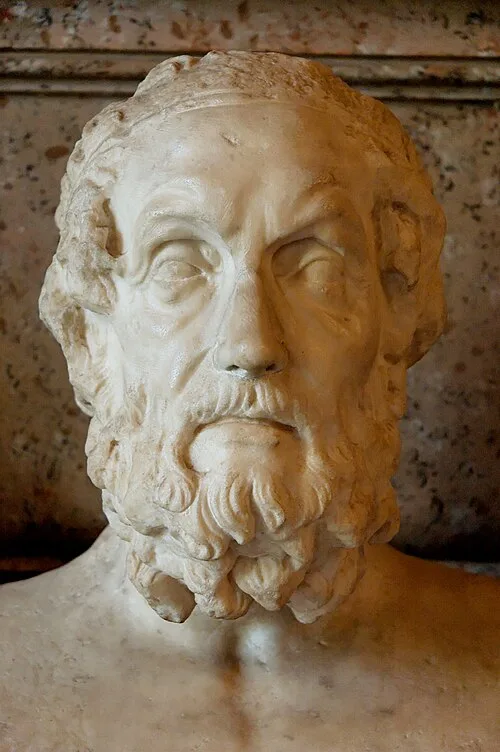
Homer
Homer Public domain, Wikimedia Commons

In the 8th century BCE Greece revived. The Greeks adapted the alphabet of the Phoenicians, adding letters for vowels. The Iliad and the Odyssey, said to be the work of a poet named Homer (poet of the Iliad and the Odyssey), took shape around this time or a little later. Tradition dates the first Olympic Games to 776 BCE, and from then on Greeks from every city met at Olympia every four years.
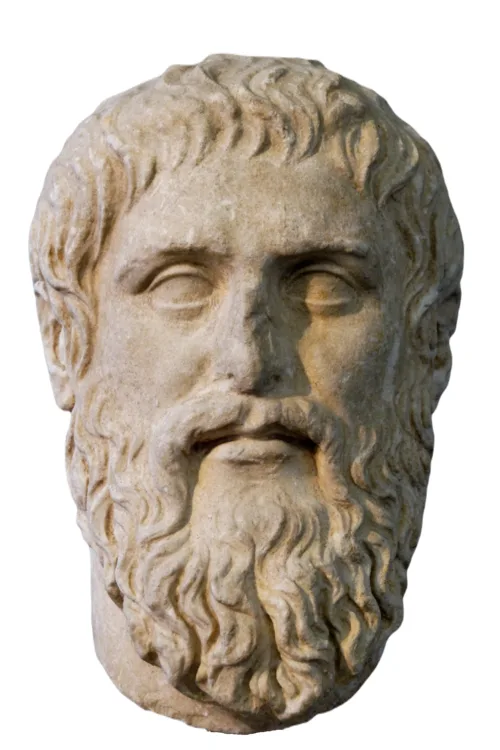
Plato
Plato Public domain, Wikimedia Commons

Greece was divided into hundreds of poleis, city-states, each with its own laws, gods and army. From about 750 BCE many sent out settlers to found new cities: Syracuse in Sicily, Massalia, today’s Marseille, Byzantium on the Bosporus and many more around the Black Sea. Plato (philosopher, founder of the Academy) later wrote that the Greeks lived around the sea like frogs around a pond.

Athens and Sparta went different ways. Sparta, which had conquered its neighbour Messenia and made its people serfs called helots, trained all its male citizens as full-time soldiers. Athens moved towards rule by its citizens: Solon (lawgiver of Athens) reformed its laws in 594 BCE, Peisistratos (tyrant of Athens) and his sons ruled it as tyrants for decades, and in 508 BCE Cleisthenes (founder of Athenian democracy) created the system later called democracy. In 499 BCE the Greek cities of Ionia rebelled against the Persian Empire, and Athens sent ships to help them.

Words worth knowing

Polis

A city-state: a town and the countryside around it, governing itself. The word politics comes from it.

Helots

The people of Laconia and Messenia whom the Spartans held as serfs to farm their land. They far outnumbered the Spartans.

Tyrant

A ruler who had seized power outside the usual rules. In Archaic Greece the word could describe a popular ruler as well as a cruel one.

Hoplite

A citizen soldier in bronze armour with a large round shield, fighting shoulder to shoulder in a close formation called the phalanx.

Did you know?

What did Olympic winners receive?

A wreath of wild olive. The fame mattered more: home cities welcomed winners with statues and honours, and Athens gave its Olympic champions free meals for life.

Did Greek athletes compete naked?

Yes. By the 7th century BCE men competed naked at Olympia and trained naked in the gymnasium, a word that comes from gymnos, “naked”. Married women were not allowed to watch the games.

What was the oracle of Delphi?

A priestess of Apollo, the Pythia, who answered questions from cities and individuals. Her answers could be famously unclear: according to Herodotus (first historian of the Greeks), Croesus (rich king of Lydia) of Lydia was told that if he attacked Persia he would destroy a great empire. He did, but it was his own.

Myth or fact?

“The Spartans threw weak babies off a cliff.”

Match the names

Tap a name, then the role that goes with it.

Check yourself

Question 1 of 3

From whom did the Greeks adapt their alphabet?

Question 2 of 3

Which city did Cleisthenes reform in 508 BCE?

Question 3 of 3

What was the prize for an Olympic victory?

Collect the seal

Answer all three questions above to stamp the Archaic Greece seal. 0 of 3 answered.

Back to the seal book