Greek history in steps
Step 1 of 11

Minoans and Mycenaeans

c. 3200–1100 BCE
Anax, “lord” or “king”; wanax in Linear B

Greece’s first great civilisations grew up in the Bronze Age. The Minoans of Crete built palaces such as Knossos and traded across the eastern Mediterranean; then the Mycenaeans of the mainland, who wrote an early form of Greek, came to rule the Aegean. Around 1200 BCE their palaces were destroyed, and Greece entered a long dark age.

About 6 minutes

Who you’ll meet

One key name in this era. Everyone else plays a smaller part: tap their name in the text whenever you need a reminder.

Also appearing (5)
Practise this era’s names

Where it happened

Tap a marker, a shaded region or a name below the map to see what happened there. Places in the text with a red pin open their own map card.

Region

Crete

Home of the Minoan palaces, the first great civilisation of the Aegean.

Shaded: today’s Crete.

Coastlines from Natural Earth. Ancient states and regions are shown by name only, without borders; shaded areas follow today’s borders as a guide.

Open the atlas to compare this map with other eras, or browse all places.

What happened

People have lived in Greece for hundreds of thousands of years, and farming arrived from Anatolia around 7000 BCE. The Bronze Age began around 3200 BCE. In the Cyclades, the islands of the central Aegean, people carved marble figures so simple and flat that to us they look strikingly modern.

On Crete, a civilisation that archaeologists call Minoan, after the legendary King Minos (legendary king of Crete), built great palaces from around 1900 BCE, at Knossos, Phaistos, Malia and Zakros. They were centres of storage, crafts and ritual, with painted walls showing bull-leaping, processions and sea creatures. The Minoans wrote in a script called Linear A, which no one has yet deciphered. Sometime around 1600 BCE a huge eruption blew apart the island of Thera, today’s Santorini, and buried the town of Akrotiri in ash; its exact date is still debated.
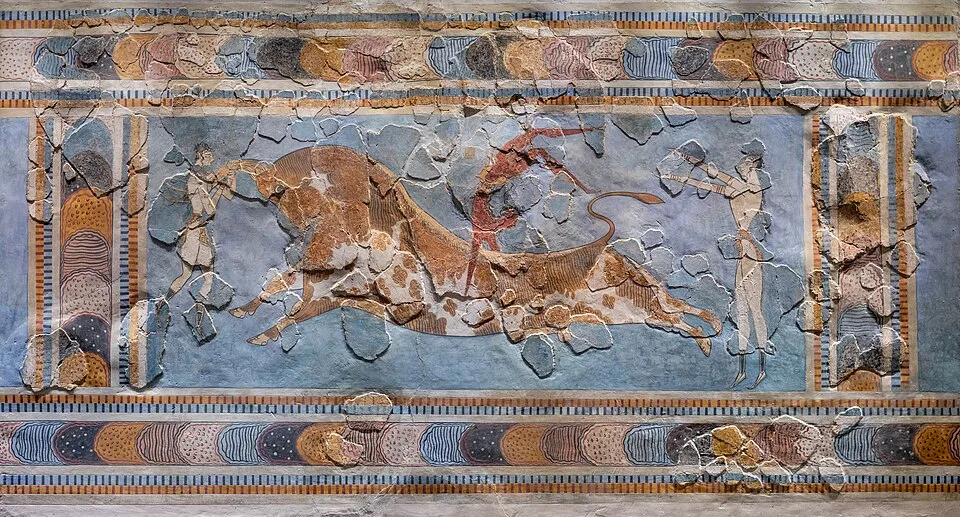
The bull-leaping fresco from the palace of Knossos, photographed in 2024.
The bull-leaping fresco from the palace of Knossos, photographed in 2024. Public domain, via Wikimedia Commons

On the mainland, rulers buried in the shaft graves of Mycenae from around 1600 BCE were laid to rest with gold masks and weapons. Their culture, called Mycenaean, built palaces at Mycenae, Tiryns, Pylos and Thebes, with walls so huge that later Greeks thought only giants, the Cyclopes, could have built them. Around 1450 BCE Mycenaeans seem to have taken control of Knossos. They kept records on clay tablets in a script called Linear B, which Michael Ventris (decipherer of Linear B) showed in 1952 to be an early form of Greek.

Around 1200 BCE many palaces in Greece were burned and abandoned, part of a wider collapse across the eastern Mediterranean that also brought down the Hittite kingdom of Anatolia. Historians still debate the causes: earthquakes, drought, revolts, raiders such as the “Sea Peoples” named in records from Egypt, and the breakdown of trade. Writing disappeared from Greece for some four centuries.

Words worth knowing

Minoan

The name Arthur Evans gave to the civilisation of Bronze Age Crete, after the legendary King Minos. What the Minoans called themselves is unknown.

Linear B

The script of the Mycenaean palaces, with about ninety signs for syllables plus signs for things and numbers. It records the oldest known form of Greek.

Megaron

The great hall at the heart of a Mycenaean palace, with a round hearth in the middle and a throne against one wall.

Tholos tomb

A beehive-shaped stone tomb built for Mycenaean rulers. The largest, known as the Treasury of Atreus, at Mycenae, is about 13 metres high inside.

Did you know?

Did the Minoans really leap over bulls?

Frescoes and small statues from Crete show young people grasping bulls’ horns and somersaulting over their backs. Scholars still discuss whether this was a sport or a ritual, and how it could be done, but the scenes are common enough to show that it mattered.

Who deciphered Linear B?

Michael Ventris (decipherer of Linear B), an English architect, announced in 1952 that Linear B was Greek, and worked out the details with the scholar John Chadwick (scholar of Linear B). Most experts had expected it to be some other language.

Was there a real labyrinth?

The myth of the Minotaur in the Labyrinth of King Minos (legendary king of Crete) may echo Knossos itself, a maze of rooms around a central court. The word labyrinth may come from labrys, a double axe, a symbol found all over the palace, though that link is debated.

Myth or fact?

“The Trojan War happened as Homer describes it.”

Match the names

Tap a name, then the role that goes with it.

Check yourself

Question 1 of 3

Which island was the home of the Minoan civilisation?

Question 2 of 3

What did the decipherment of Linear B show in 1952?

Question 3 of 3

Which island’s volcano buried the town of Akrotiri?

Collect the seal

Answer all three questions above to stamp the Bronze Age seal. 0 of 3 answered.

Back to the seal book