Step 4: Alexander, 404–323 BCE
Alexander the Great
Conqueror of the Persian Empire
356–323 BCEOne of the 22 key names
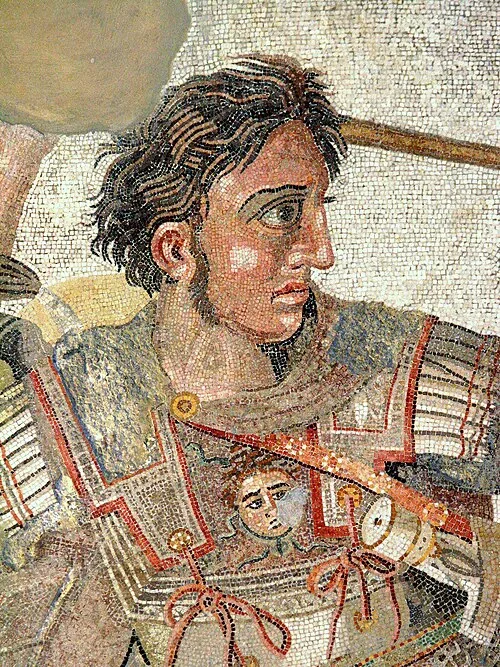

Alexander the Greathis name and the title later given to himthe name to use
King of Macedon from 336 BCE, son of Philip II and pupil of Aristotle. In eleven years he conquered the Persian Empire from Egypt to the Indus, founded Alexandria and many other cities, and spread Greek culture across the east. He died at Babylon aged 32.
Memory hook
Alexandros joins alexein, “to defend”, and anēr, “man”: “defender of men”. Picture the young king throwing his spear onto the shore of Asia before he leapt ashore.
Family line
Already in your name cards. New
In the story
Step 4: Philip and Alexander
- His son Alexander the Great conquered the Persian Empire and marched as far as India before dying at Babylon in 323 BCE, aged 32.
- In 336 he was murdered, and his son Alexander, aged 20, became king.
- In 334 BCE Alexander crossed into Asia.
Step 5: The Hellenistic world and Rome
- Alexander’s generals divided his empire into kingdoms ruled by Greek-speaking dynasties, and Greek became the common language of the eastern Mediterranean.
- After Alexander’s death his generals, the Successors, fought over his empire for some forty years.